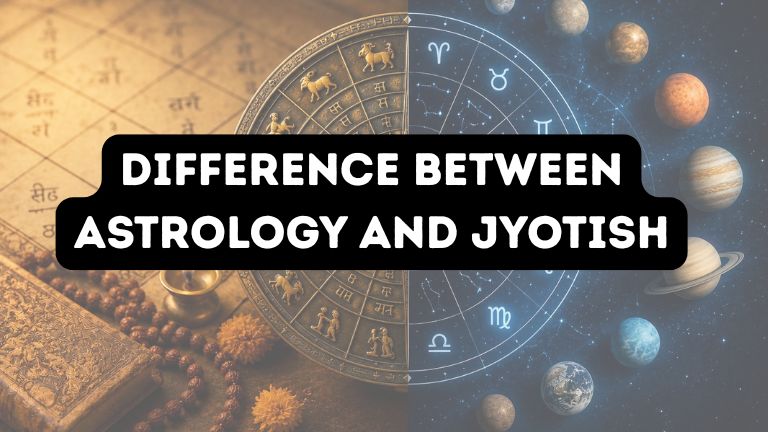
Many people use the terms astrology and Jyotish interchangeably, assuming they mean the same thing. While both systems study the influence of celestial bodies on human life, there are important differences between them. Understanding the difference between astrology and Jyotish can help individuals choose the approach that best aligns with their interests and spiritual beliefs.
Astrology is a broad term that covers various systems practiced across the world, including Western Astrology, Chinese Astrology, Mayan Astrology, and Vedic Astrology. Jyotish, on the other hand, specifically refers to the ancient Indian system of Vedic Astrology rooted in the Vedas.
In this article, we will explore the difference between astrology and Jyotish, their origins, methods, calculations, philosophies, and how each system approaches predictions and guidance.
What Is Astrology?
Astrology is the study of the relationship between celestial bodies and human life. It is based on the belief that the positions and movements of planets, stars, and other celestial objects may influence events and personality traits.
Different cultures have developed their own forms of astrology over thousands of years.
Some popular forms include:
- Western Astrology
- Chinese Astrology
- Hellenistic Astrology
- Mayan Astrology
- Psychological Astrology
- Vedic Astrology
When people refer simply to “astrology,” they often mean Western Astrology, which is widely practiced in Europe and North America.
What Is Jyotish?
Jyotish, also known as Vedic Astrology, is one of the oldest astrological systems in the world. The word “Jyotish” comes from Sanskrit and means “science of light.”
Jyotish is considered one of the six Vedangas, the auxiliary disciplines associated with the Vedas. It has been practiced in India for thousands of years and continues to play an important role in spiritual and cultural traditions.
Jyotish focuses on understanding:
- Life purpose
- Karma
- Destiny
- Relationships
- Career
- Spiritual growth
- Health
- Financial opportunities
Unlike many modern astrological systems, Jyotish places significant emphasis on karmic influences and spiritual development.
Difference Between Astrology and Jyotish: Overview
Although Jyotish is a form of astrology, there are several important distinctions.
| Astrology | Jyotish |
|---|---|
| Broad category covering many systems | Specific Vedic system from India |
| Often refers to Western Astrology | Based on ancient Vedic scriptures |
| Uses Tropical Zodiac | Uses Sidereal Zodiac |
| Focuses on personality and psychology | Focuses on karma and life path |
| Less emphasis on remedies | Strong emphasis on remedies |
| Modern interpretations common | Traditional Vedic principles |
Understanding these differences helps explain why predictions from Western Astrology and Jyotish can sometimes differ significantly.
Origin and Historical Background
Astrology
The roots of astrology can be traced back to ancient civilizations such as:
- Mesopotamia
- Egypt
- Greece
- Rome
Over centuries, astrology evolved into different schools of thought, especially in Europe.
Western Astrology as practiced today largely developed from Greek and Roman traditions.
Jyotish
Jyotish has its origins in ancient India and is deeply connected to the Vedic tradition.
Ancient sages used celestial observations to understand cosmic influences and human destiny.
Texts such as:
- Brihat Parashara Hora Shastra
- Brihat Jataka
- Saravali
form the foundation of modern Jyotish practices.
Tropical Zodiac vs Sidereal Zodiac
One of the most important aspects of the difference between astrology and Jyotish is the zodiac system used.
Western Astrology Uses the Tropical Zodiac
Western Astrology calculates zodiac signs based on the Earth’s relationship to the Sun and the seasons.
The Tropical Zodiac remains fixed relative to the equinoxes.
As a result:
- Aries always begins at the spring equinox.
- Zodiac positions remain season-based.
Jyotish Uses the Sidereal Zodiac
Jyotish uses the Sidereal Zodiac, which is based on the actual positions of constellations in the sky.
Because of a phenomenon called precession, the Sidereal Zodiac gradually shifts over time.
This often results in a person’s zodiac sign being different in Jyotish compared to Western Astrology.
For example:
- A person who is a Leo in Western Astrology may be a Cancer in Jyotish.
Focus and Philosophy
Western Astrology
Western Astrology often focuses on:
- Personality traits
- Emotional tendencies
- Relationships
- Psychological development
- Self-discovery
Many modern astrologers use astrology as a tool for personal growth and understanding behavioral patterns.
Jyotish
Jyotish takes a broader spiritual approach.
It focuses on:
- Karma
- Dharma (life purpose)
- Spiritual evolution
- Life lessons
- Past influences
- Future opportunities
The goal is not only prediction but also self-awareness and spiritual progress.
Birth Chart Interpretation
Another major difference between astrology and Jyotish lies in chart interpretation.
Western Astrology Chart
Western Astrology typically emphasizes:
- Sun Sign
- Moon Sign
- Rising Sign
- Planetary aspects
The Sun Sign often receives the greatest attention.
Jyotish Birth Chart
Jyotish places significant importance on:
- Lagna (Ascendant)
- Moon Sign
- Nakshatras
- Planetary periods (Dashas)
- House lords
- Yogas
- Doshas
The analysis tends to be more detailed and predictive.
Importance of Nakshatras
Nakshatras are one of the unique features of Jyotish.
The sky is divided into 27 lunar constellations known as Nakshatras.
Each Nakshatra carries specific qualities and influences.
Nakshatras are used for:
- Marriage matching
- Career analysis
- Muhurat selection
- Spiritual guidance
Western Astrology generally does not use Nakshatras.
Predictive Techniques
Western Astrology
Common predictive methods include:
- Planetary transits
- Progressions
- Solar returns
These methods focus on psychological and life trends.
Jyotish
Jyotish employs additional predictive systems such as:
- Vimshottari Dasha
- Planetary transits (Gochar)
- Divisional charts
- Ashtakavarga
These techniques provide detailed timing of life events.
Many people believe Jyotish offers highly specific timing predictions because of these advanced methods.
Remedies in Jyotish
One of the most significant differences between astrology and Jyotish is the use of remedies.
Western Astrology generally focuses on understanding and awareness.
Jyotish often recommends remedies such as:
- Mantra chanting
- Gemstones
- Charity
- Fasting
- Meditation
- Spiritual practices
- Temple visits
The purpose of these remedies is to strengthen positive planetary influences and reduce challenges.
Career Guidance
Both systems can provide career insights, but they approach the topic differently.
Western Astrology
Career guidance often focuses on:
- Natural talents
- Personality strengths
- Interests
Jyotish
Career analysis includes:
- Planetary combinations
- Dasha periods
- House analysis
- Professional timing
This can provide more detailed information about career opportunities and challenges.
Marriage and Relationship Analysis
Relationship analysis is another area where the difference between astrology and Jyotish becomes evident.
Western Astrology
Uses synastry and compatibility charts to evaluate relationship dynamics.
Jyotish
Uses detailed methods including:
- Kundali matching
- Guna Milan
- Manglik analysis
- Seventh-house evaluation
Marriage compatibility is one of the most commonly requested Jyotish services in India.
Which Is More Accurate?
One of the most common questions people ask is whether astrology or Jyotish is more accurate.
The answer depends on the individual’s perspective and goals.
Western Astrology is often appreciated for:
- Personality analysis
- Emotional understanding
- Psychological insights
Jyotish is often valued for:
- Detailed predictions
- Karmic understanding
- Life-event timing
- Spiritual guidance
Both systems have loyal followers and experienced practitioners who achieve meaningful results.
Which One Should You Choose?
Choosing between astrology and Jyotish depends on what you hope to gain.
Consider Western Astrology if you want:
- Personality insights
- Emotional awareness
- Self-discovery
- Relationship understanding
Consider Jyotish if you want:
- Detailed life predictions
- Career guidance
- Marriage analysis
- Karmic understanding
- Spiritual growth
- Astrological remedies
Many people study both systems to gain a broader understanding of themselves and their life journey.
Final Thoughts
Understanding the difference between astrology and Jyotish helps clarify why these two systems sometimes produce different interpretations and predictions. Astrology is a broad field that includes many traditions, while Jyotish is the ancient Vedic system rooted in Indian spiritual wisdom.
Western Astrology focuses largely on personality, psychology, and self-awareness, whereas Jyotish emphasizes karma, destiny, life purpose, and spiritual development. Both systems offer valuable insights, and neither is inherently superior. The right choice depends on your goals, beliefs, and the type of guidance you are seeking.
Whether you explore Western Astrology, Jyotish, or both, these ancient traditions continue to help millions of people gain deeper insight into their lives, relationships, and future possibilities.
ALSO READ
Best Janam Kundali Astrologer in Noida
Best Janam Kundali Astrologer in Varanasi
Sunderkand Path Benefits in Hindi
Pind Daan at Triveni Sangam Prayagraj
Janam Kundali Services in Kanpur